ScannBI Technology
Evofinder® system
The detail behind each part: the X Series scanner, how the 3D surface is built, the examiner’s software and how data moves between laboratories.
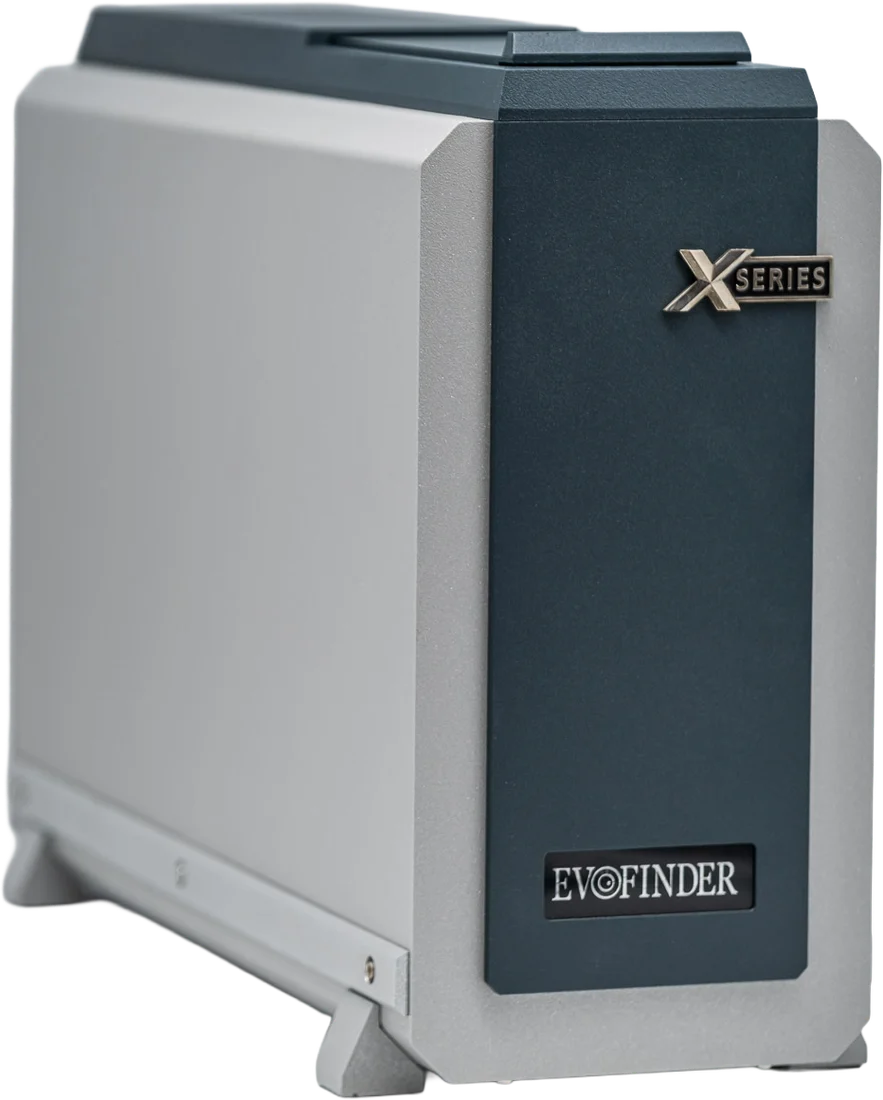
Scanner
Evofinder® X Series
The Model 10 scanner, designed and built in-house: twice the lateral resolution of Model 9, self-locking lead-screw axes and one cassette for bullets and cartridge cases.
| Resolution | 1.79 µm per pixel560 px per mm, X–Y |
|---|---|
| Field of view | up to 3.6 × 2.7 mmone camera frame |
| 3D scan time | under 1 mintypical 9×19 mm bullet or case head |
| Bullets | up to 26 mmdiameter; up to 66 mm high in the cassette |
| Cartridge cases | up to 26 mmdiameter; up to 101 mm long |
| Axes | lead screwsself-locking, no locking screws for transport |
Source: ScannBI Technology data

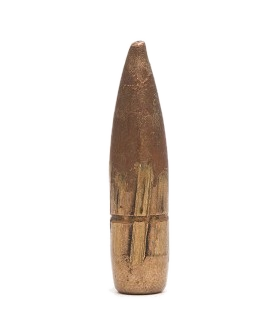 The scanner rotates the bullet and records its whole side surface as one flat strip, so land and groove impressions can be compared along their full length.
3D technology
3D surface acquisition
Firing pin and breech face marks are a few microns deep. They appear only when light falls across the surface. The scanner records the surface in 3D, so the examiner can move the light afterwards — here it circles the case on its own.
Software
Correlation and comparison
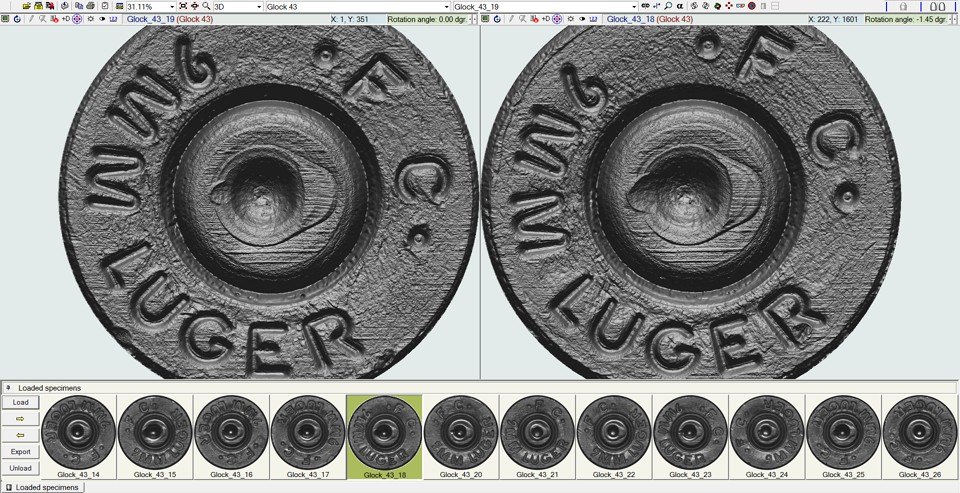
Expert Working Station, release 7.1. Open the points on the screen to see what the examiner works with.
Expert Working Station
- CompareScale, rotate, overlay, change the light, measure distance, angle and depth.
- LinkConnect objects and cases after a confirmed match.
- Pre-filtersAmmunition type, weapon system, examiner, case.
- ReportsReports and printing for the case file.
Specimen Analysis System
- CorrelationAutomatic comparison of every new scan with the database.
- RankingCandidates ordered by similarity.
- BackupBuilt-in backup of the database.
- ScalingAdd DAS and EWS stations as the lab grows.
How a hit list forms
Network & data
Each lab on its own, connected when needed
Evofinder® does not depend on a central server. A lab searches its own database and opens a neighbour’s when a case calls for it.
Data exchange
Scans stay with the agency
The database runs on the agency’s own servers. A partner laboratory connects to it directly over a secure network, VPN, LAN or WAN, searches it in a short session and sees the candidates. The scans themselves stay where they are.
In addition, any scan can be exported as an X3P file (ISO 25178-72), the open format for surface topography, for a laboratory that works on a different system.